


Today I saw a billboard advertising for bus drivers. $20,000 a year.
I was struck by how odd it was that they’d put such a pathetic salary right there in the ad. Like that was supposed to attract somebody. And it got me thinking about what kind of Christmas that family has coming. Will they have people over? Will they have a nice home-cooked meal? They’re likely one of the 1 in 8 Americans on SNAP benefits. Have they been worried the last few months as politicians screw with those programs again?
Then it got me thinking about expectations. How low ours have become.
We don’t seem to think we’re owed much by a system that pumps out billionaires and trillion-dollar companies. Any little bit we do get is called an “entitlement”—said like a slur. People are ashamed of their financial struggle, and often afraid to call it poverty. Poverty is something shameful that happens to other people. People with less than us.
But it’s ok to struggle. It’s expected. ‘No one said life was going to be easy.’ We’ve been sold the lie that we’re completely to blame. If only we’d done this or not done that, we too could have a mansion and a yacht.
Every December, kids sit down and write out what they want for Christmas. If we want to understand this country, don’t look at what ends up under the tree. Look at what different kids think it’s reasonable to ask for in the first place.
That bus driver’s kid? They’re not writing “PlayStation 5” or “trip to Disney.” They’re hoping Christmas isn’t a fight. They’re hoping the heat stays on. Maybe a toy from the dollar store. The real wish is that mom isn’t stressed and dad isn’t angry. Their list is basically please let things not be worse.
The kid in the maxed-out middle class house has a different list. This kid thinks the family is doing fine because every visible signal says ‘normal.’ House, car, iPhones, streaming subscriptions. They’re asking for the new game system, the concert tickets—because nobody told them they’re one medical bill away from the whole thing collapsing. The parents are drowning. But the performance of stability is intact.
The wealthy kid asks for a car. A trip. New everything. Not as fantasy but as reasonable expectation. ‘Want’ and ‘get’ live close together for them.
But keep going up. Past wealthy into the stratosphere where the real money lives.
Those people stopped writing letters to Santa a long time ago. They don’t ask for things. They acquire systems. They don’t want a nicer phone—they want the company that makes the phones. They don’t want better news coverage—they buy the network. They don’t ask the government to prioritize space programs—they build their own rockets.
Elon Musk didn’t buy Twitter because he wanted to tweet more. At a certain level of wealth, expectations aren’t about having—they’re about owning. Owning industries. Owning the conversation. Owning what used to be public functions of the state. These aren’t Christmas lists. They’re bids for power itself.
So while half the country has been trained to believe that wanting a house is being entitled, a handful of people think it’s perfectly reasonable to own the entire housing market.
Same country. Completely different ideas of what’s possible.
From the 1930s through the 1970s, regular people’s expectations rose and reality met them. One income could support a family. You could buy a house in your 20s. You could have kids without staring at a spreadsheet every night. If you worked hard, you could get ahead.
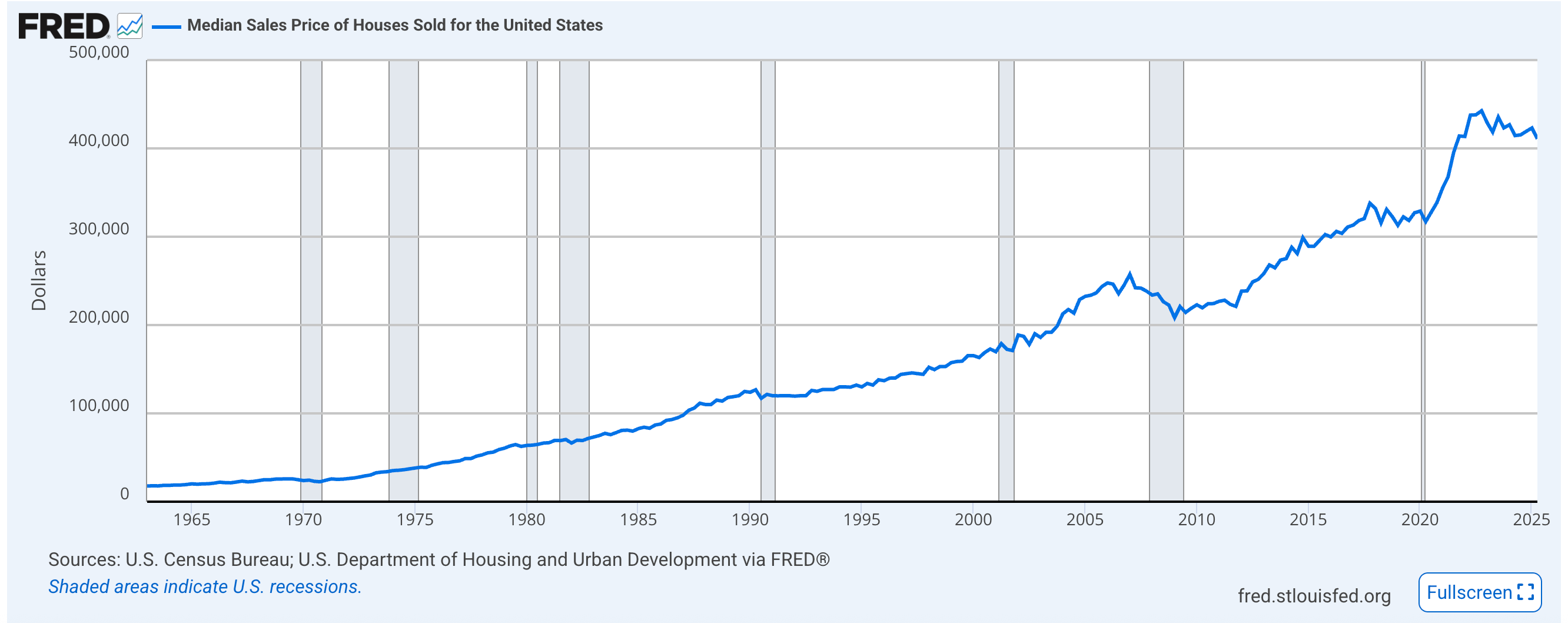
As I showed in The Great American Pay Cut, in 1950, the median home cost about 2.1 years of median household income. Today it’s over 5, and in a lot of markets closer to 10. Healthcare was a bill, not a bankruptcy event. College could be paid for with a summer job. One parent working a union job could carry a family of four into genuine stability—house, car, vacation, retirement.

That period was the closest this country ever came to living up to its own marketing. The biggest compression of the gap between rich and poor we’ve ever seen. When “middle class” meant stability, not vibes.
Then we spent 40-plus years walking it back.
You don’t wake up one day and realize your expectations have been lowered. You just look up 20 years later and everything got harder. Housing, healthcare, childcare, education—all of it takes more hours of your life to afford than it did for your parents. Way more than your grandparents.
And we’ve been sold a story about why. It’s your fault. You didn’t pull yourself up by your bootstraps. You didn’t work hard enough. You made the wrong career choice. You didn’t learn to code. You didn’t move to where the jobs are. Some mistake you made is why you’re not rich and famous in America—after all, it’s the land of opportunity, the land of dreams.
That mythology is still alive. You can be anything if you just put your mind to it. Even though there’s overwhelming evidence that if you’re born poor, you’ll likely stay poor. Even though you’ll watch trillionaires be made off investments your grandparents put in. Even though the inheritance that should have been yours—the purchasing power, the stability, the reasonable expectation of a decent life—has been stripped away and handed to people who already had more than they could ever spend.
The economy exists at our pleasure. The market is supposed to serve the people of this country, not the other way around. But somewhere along the line, that got flipped, and most of us forgot it was ever different.
We live in the richest nation in history. We can conjure trillions for banks and wars and bailouts in a weekend. We can build stealth bombers and Mars rovers and computer chips so advanced they seem like magic. But we’ve been convinced that affordable housing and public healthcare and childcare are impossible dreams.
They’re not. We’ve built them before. We just stopped. Stopped, in part, because we were afraid someone ‘undeserving’ might get more than their share. Which is laughable now that the US has almost 12,000 centi-millionaires and billionaires.
Now, in a lot of households, the ‘ambitious’ goal is simply not being economically crushed. Not getting evicted. Not going under when the car dies or the kid breaks an arm. People are proud—and they should be—of keeping their heads above water. But look at what we’ve been convinced to call ‘success.’ Survival. Meanwhile, at the very top, a handful of people buy media companies to control the conversation, build private space programs to replace public ones, and purchase politicians the way the rest of us purchase groceries.
The billionaire who wants to own everything is celebrated as a visionary. The worker who wants to own a home is told to lower their expectations. That’s the scam.
Your expectations are shaped by your circumstances. But your circumstances are shaped by systems that other people designed. And in this country, a political and economic elite spent decades quietly lowering your expectations so they wouldn’t have to raise your living standards.
That’s the trick. If they can convince you that wanting a house is entitled, that expecting healthcare is naive, that hoping your kids do better than you is old-fashioned thinking—then they never have to deliver anything. They just have to manage your disappointment. Keep you grateful for scraps. Keep you blaming yourself or your neighbor instead of the people who rigged the game.
We are not asking for too much. We’re asking for what we already proved was possible.
The richest country in the history of the world should not be producing Christmas lists where the most common wish is, “I hope we’re okay.” We are allowed to want more than survival. We need to demand the return of the future they stole.
Corbin Trent
The Pools We Filled and the Prosperity We Gave Away

For all the Saving Private Ryans and movies about the Second World War, we've yet to turn into heroes those who did the work that really expanded and built our society. It's a much more complicated story, I guess, or at least less visceral. It's a story about building through the Great Depression, building through the New Deal, building and preparing, h…
Like much of Corbin's writing, this piece is chock-full of lines that I wish were on billboards throughout the county and on our TVs every bit as often as the damn pharmaceutical and lawyer ads. Pick a line and put it on a billboard or a TV ad in your town. People running for office can find their campaign's motto in here. This is a gold mine.
“This happened because caring for everyone was never the goal of capitalism. The goal of capitalism is to extract labor from the working class and resources from the global south to sell goods and services at a rate that generates profit for the owners of the means of production. That’s it.
Capitalism has no wisdom. It will start wars to generate profit. It will have impoverished populations toiling in mines and sweatshops for pennies in order to generate profit. It will burn up critical drinking water supplies for AI data centers in order to generate profit. It will cut down the last acre of old-growth rainforest in order to generate profit. It will pollute the air, fill the oceans with plastic and kill all the insects if offloading the cost of industry onto the ecosystem helps generate profit.
The entire world is being consumed by an artificially imposed system which holds as its foundational premise that mass-scale human behavior should be driven by the pursuit of profit for its own sake. It’s a mindless, planet-devouring machine of our own making. It is creating unfathomable destruction and suffering for terrestrial organisms of every species.”
https://www.caitlinjohnst.one/p/the-craziest-thing-in-the-world-is