



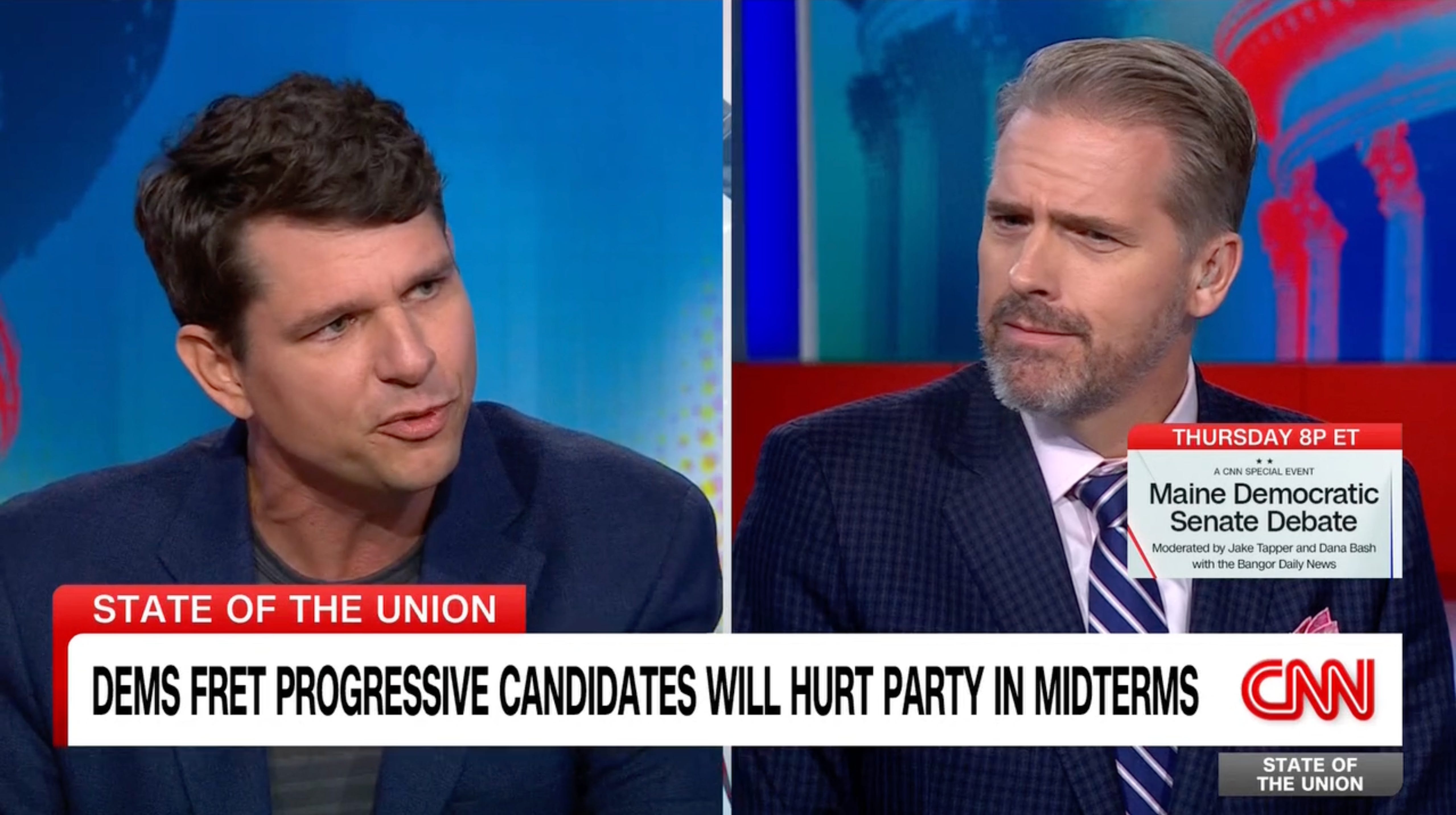
Sunday, I was on CNN’s State of the Union talking with Scott Jennings about how this country actually got built. Public money. Public works. Things we paid for together because no private market was ever going to build them.
He bought into the lie we’ve all be told for the past fifty years. Our government can’t build anything and socialism is a foreign disease. Yet, people are listening to socialists anyway. Not because somebody handed them a DSA pamphlet. Because the math of a normal life stopped working and we want our lives back. People want solutions.
We're backing candidates across this country who will actually fight for this. Not the ones who'll manage the decline gracefully. The ones who'll build. Help us get them elected. A Fight Worth Having
I find myself frustrated with the sole obsession with taxing the rich. The trillionaire, the billionaires and the centi-millionaires. Not because we shouldn’t do it. We should.
The gap between the ultra rich and the rest of us is insane. A lot of what they’re holding is ours, earned by the people who keep this thing running. But taxing the top is the easy part. What we do with the revenue is what matters.
It frustrates me because wealth taxes are treated like the whole solution. They aren’t.
The sectors that carry your life have broken. Health care. Housing. Child care. Education. Energy. They don’t work like markets anymore.
A working market takes money and makes more of the thing. Capital goes in, supply comes out. That’s the deal. That’s the only reason anybody ever defended markets in the first place.
These don’t do that. Put money into health care and you don’t get more doctors, you get more consolidation. Put money into housing and you don’t get more houses, you get a higher price on the same house. Send more money to college and lo and behold, the university gives an administrator a raise. The cash never turns into supply.
We’ve run that test in every one of these sectors since the ‘50s and it comes back the same way every time. Money goes in, supply sits still, price goes up, and somebody at the top takes the difference.
It’s not that our market is being unfair. It’s stopped functioning as a market. Our economy has gotten terrible at producing and amazing at extracting.
Now put inequality on top of that.
Inequality is what keeps the whole thing from being obvious. We’re broke, so we get sorted out early and never find out that the thing we couldn’t afford also doesn’t exist in anything close to the numbers we need. The price does the rationing before anybody gets in line. No line ever forms. No shortage ever shows up on the news. And we all walk away thinking the problem was money, because money is what we ran out of first.
You all are the ones paying me to say this. This newsletter and everything else we put out runs on regular people chipping in. If it's worth your time, help us keep it going. afightworthhaving.com
So the whole country argues about distribution. Tax the top. Raise the wage. Grow the credit. I want the money to move and I’ve said that plain. But hand it over tomorrow with these sectors in the shape they’re in and we’d watch it get eaten in real time. Not because we did anything wrong. Because we fed money to something that turns money into price instead of into supply.
That’s what the inequality is hiding from us. We don’t have a fairness problem. We have a production problem.
That money needs to go into building. Public building. Things we build, things we own, things we get to set the price of. Not into helping us pay whatever a broken sector decides to charge.
When a country pools this much cash at the top, you get inflation in two places at once.
You get it in assets. Stocks. Private companies valued at numbers that make no sense. Luxury homes, art, handbags, yachts, whatever the very rich buy to keep score.
And you get it in the short list of things we can’t opt out of buying. Housing. Health care. Child care. Power and water. College.
That asset run-up gets called appreciation. It isn’t. When a price runs away from what the thing actually produces, it isn’t value. It’s a bubble. No productivity behind it. No profits, no market share, nothing underneath. It’s a tulip bulb market. And that’s where fifty years of this country’s money went.
The Federal Reserve’s own distributional financial accounts show it. In 1989 the top 1 percent held about 23 percent of net worth. By the end of 2025, about 31 percent. The bottom half went from 3.5 percent to 2.5 percent.
So yes, we’ve had inflation. Enormous inflation.
And we’ve felt it. I’m not here to tell you that you haven’t. We’ve seen more of it than anybody. Housing, health care, child care, college, the power bill creeping up every year. We get told it’s under control, because the damage doesn’t show up in the index they measure. Hidden in debt. Hidden in extra labor. Hidden in subsidies. Hidden in parents helping grown children. Hidden in people not having kids. Hidden in people giving up on a home. Hidden in all the small ways we quietly give things up.
The same thing happened up top, just running the other direction. Money poured into stocks and land and AI. So the people already holding it got richer for holding. Not for building. For holding.
We all watched this happen fast a few years ago. A pandemic broke the supply of damn near everything and prices went straight up. Eggs and gas and rent all at once. Supply drops, price climbs, and it doesn’t matter what’s in anybody’s pocket. That’s the same engine that’s been running slow on housing and health care and child care for fifty years. The slow version doesn’t get called an emergency, because it landed on us and not on them. But it’s the same engine. The steady story isn’t the price of eggs. It’s the price of a house, a degree, a hospital stay, a month of day care, climbing decade after decade while our wages sat still.
Homes are where it breaks into regular life. A median new home cost about 6.3 years of median personal income in 1963. By 2024 it was about 9.3 years. A house used to cost a little over six years of your life. Now it costs more than nine. And we’re still told to keep up.
Health care did the same thing. Spending per person ran about 5.5 percent of median personal income in 1960. By 2024 it was about 34 percent.
The price of a normal life went up faster than the pay.
We already know this. We know it when we look at a house listing. We know it when the hospital bill comes. We know it when a decent life takes two incomes, a credit card, student loans, a car note, and no room for anything to go wrong.
We covered the gap for a while. The one-earner household became the two-earner household. That was liberation in a lot of ways and I wouldn’t trade it away, but it also became a financial necessity, and everybody acted like the family got richer without asking why it took twice the labor to stand in the same place. Then we covered it with debt. Then with subsidies. Medicaid, housing vouchers, student aid. I’m glad they exist and a lot of us would be drowning without them. But look at what they did to the price. We poured federal money into college tuition for forty years and tuition ate every dollar of it. We hand out housing vouchers in cities that won’t permit housing and the rent absorbs them. A subsidy that isn’t paired with supply doesn’t bring the price down. It becomes the price.
We already ran that experiment. Five decades of sending money at these sectors and it kept getting swallowed, because we never built the thing the money was trying to buy.
I bring this number up a lot. RAND put the gap at about $79 trillion through 2023. That’s the difference between what the bottom 90 percent actually earned since 1975 and what we’d have earned if growth had been shared the way it was after World War II.
That money didn’t disappear. It moved up.
And while it moved up, we let the real economy rot underneath it. We stopped building homes. We stopped building infrastructure. We stopped building cities. We offshored the factories and let financial engineering pay better than production. Manufacturing employment peaked around 19.5 million workers in 1979. In 2024 it was about 12.8 million.
We got very good at making money and a lot worse at making the things money is supposed to buy.
If Democrats only talk about redistribution, they’re telling half the story. If Republicans only talk about production, they’re lying, because the actual program is tax cuts, deregulation, and letting monopolies keep bleeding us dry.
So we have to build it ourselves.
Public building. Public ownership. Public competition in the markets nobody can opt out of. Health care. Housing. Child care. Education. Energy and utilities. The infrastructure itself.
Not a subsidy for a private developer. Not a credit that helps a family pay a price somebody else set. We build the thing, we own the thing, and where a private market has learned to make scarcity profitable, we get in that market and compete.
The competing part is what really scares them. A public builder putting up housing at cost drags the price down on every unit around it. A public option sets a ceiling nobody can charge above. We’ve known this a long time. Where I live, TVA and the rural electric co-ops proved it before most of the people arguing about socialism today were born.
And none of it will work until we can actually do it. Fifty years of contracting everything out hollowed out our government’s ability to build and hollowed out the workforce that used to know how. You can’t build what you can’t staff. Getting the competence back into public agencies and the skills back into working hands isn’t a side project. It’s the project.
Anything less just helps us afford a broken system. This changes who owns it and what it makes.
Inequality didn’t just make this country unfair. It hid the fact that we stopped building the things we need to live.
And all that money sitting up top isn’t doing anything. It isn’t building a house or training a doctor or opening a clinic. It’s parked in a bubble, waiting to be worth more.
Put it to work.
Corbin Trent
This message doesn't spread on its own. We're running ads, making videos, and publishing this thing so it lands in front of people who've never heard it once. Help us reach them. afightworthhaving.com
I agree with this solution.
I also remember when the government owned its buildings-like post offices. Now the post office closest to me moves every few years since they’ve been forced to rent from private owners. All this costs a whole lot more than when the government was allowed to own its buildings, which in turn gets passed on to us.
This is broadly true and I agree we desperately need more/better housing/education/healthcare/good things, but some aspects of this scarcity are not a plot or evidence of market forces failing, but perversely result from the labor market *working* to unfortunate effect. There's a phenomenon called Baumol's Cost Disease: roughly, it explains that if some parts of the economy become more productive, it drives up costs even in unrelated sectors.
Imagine a city like San Francisco experiencing a tech boom: software is going crazy, computers are getting 100x better/faster/cheaper every few years. Anyone who is clever enough to be a high school science teacher could instead go become a web developer and triple their salary overnight. Education hasn't gotten any better or more efficient, but suddenly you have to pay more to attract and retain your teachers.
Some variation of this effect is at play in most of these sectors like healthcare or education that are not susceptible to efficiency gains and automation. The financial sector has been wildly profitable over the past four decades, and so many of the top students have flocked to finance. It costs more to hire a math teacher because so many potential math teachers are now Wall Street quants.
https://en.wikipedia.org/wiki/Baumol_effect